Segments
A segment is a saved group of known members, defined by rules over their profile: how much they read, how often they visit, their membership level, whether they give, and so on. Use segments to size an audience, export it, or target it from an interaction, a cohort, or a meter.
Allegro keeps each segment's membership up to date as member profiles change, so a segment always describes who matches its rules now, not who matched when you built it.
To see your segments, go to Segments in the main navigation.
The Segments list
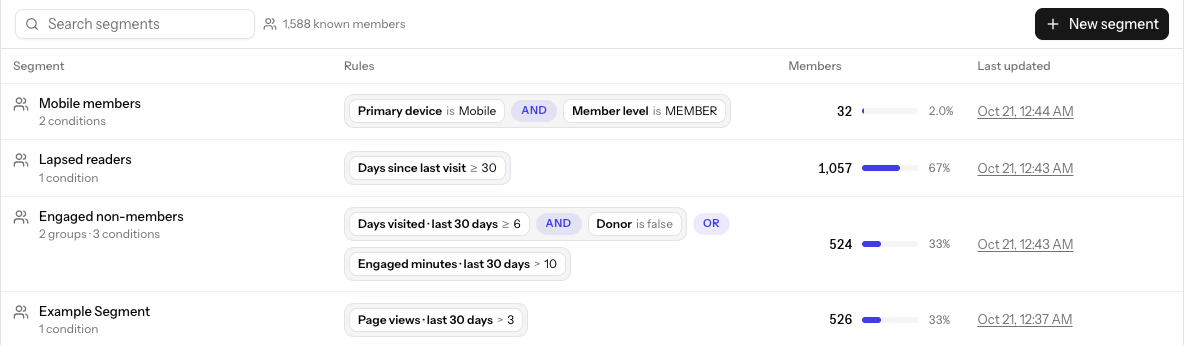
Above the list, Allegro shows how many known members your organization has — the total every segment's share is measured against. Use the search box to find a segment by name.
| Column | Description |
|---|---|
| Segment | The segment's name and how many groups and conditions it has. Click the name to open it. |
| Rules | A compact summary of the conditions. Conditions in a group are joined by AND or OR, and a pill between groups shows how the groups combine. |
| Members | How many members are in the segment now, and their share of all known members. |
| Last updated | When the segment's rules or name were last saved. |
Each row has a menu with these actions:
| Action | What it does |
|---|---|
| Edit | Opens the segment editor. |
| Duplicate | Saves a copy named "… (copy)" with the same rules and opens it, so you can build a variation. |
| Export CSV | Exports the segment's members. See Exporting a segment. |
| Delete | Permanently deletes the segment. See Deleting a segment for when this is blocked. |
If Allegro can't reach the analytics engine to count a segment, the row shows Count unavailable rather than 0. A 0 always means no members match.
Building a segment
Click New segment to open the segment editor. Click the title at the top left to name the segment; until you do, it's called Untitled segment.
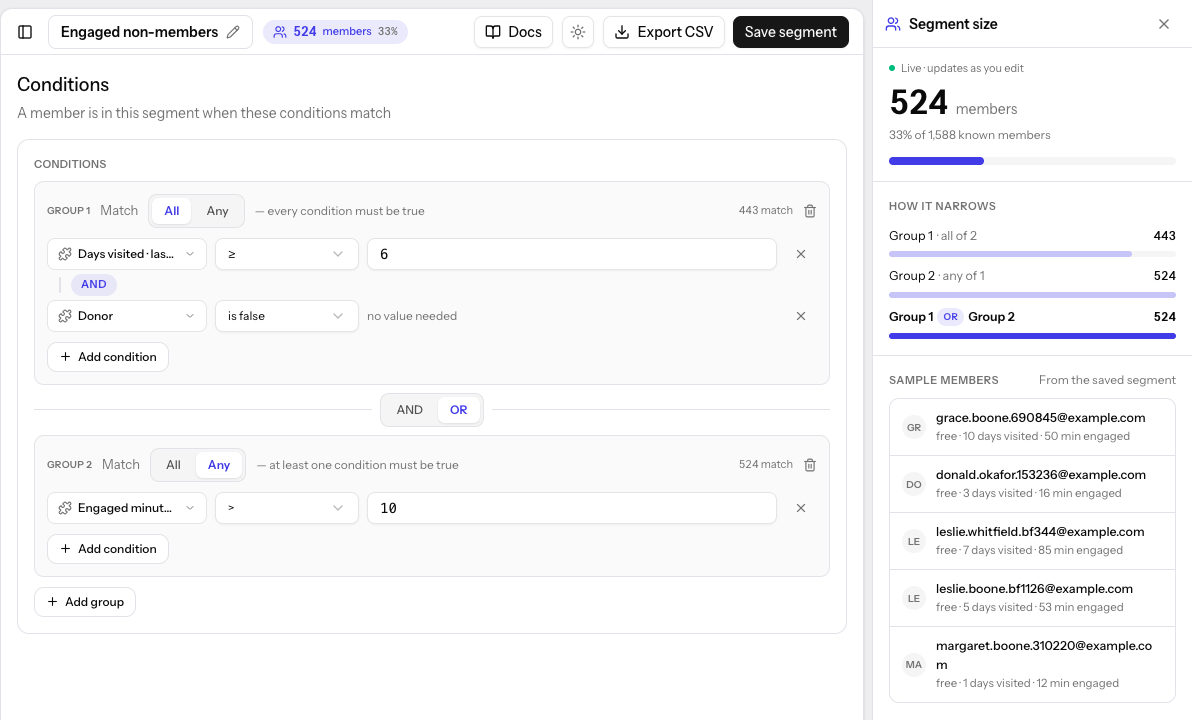
A member is in the segment when its conditions match. Conditions work the same way they do in an interaction's journeys:
- Groups. Each group has one or more conditions. Set the group's Match to All (every condition must be true) or Any (at least one must be true).
- Combining groups. Between groups, choose AND or OR. AND binds
tighter than OR:
A AND B OR Cmeans "(A and B) or C". - Adding conditions. Click Add condition in a group, or Add group for a new group. Each condition is an attribute, an operator, and (for most operators) a value.
Click Save segment when you're done. A segment with an unfinished condition can't be saved until you complete or remove that condition.
Choosing a field
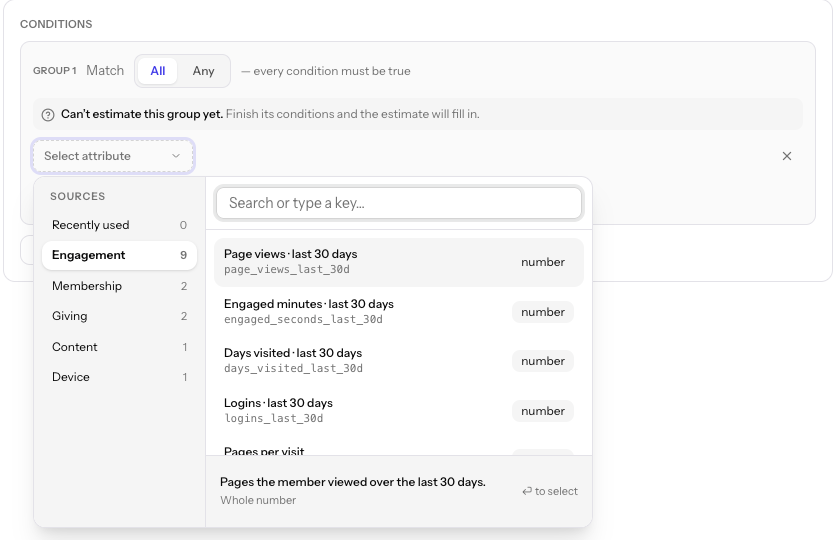
Click Select attribute in a condition to open the field picker. Fields are grouped by source; type to search across all of them. The bottom of the picker describes the highlighted field and the kind of value it takes.
| Source | Fields |
|---|---|
| Engagement | Page views · last 30 days, Engaged minutes · last 30 days, Days visited · last 30 days, Logins · last 30 days, Pages per visit, Days since last visit, Lifetime page views, Lifetime days visited, Lifetime logins |
| Membership | Member level, Sign-up gate |
| Giving | Donor, Total donations |
| Content | Top content section |
| Device | Primary device |
The operators depend on the kind of field:
| Field kind | Operators | Value |
|---|---|---|
| Text | is, is not, is one of, is not one of, contains, does not contain | Text, with suggestions drawn from values your members actually have |
| Number | =, ≠, >, ≥, <, ≤, between | A number, or two for between |
| Yes / no | is true, is false | None |
A member with no value for a field matches none of that field's conditions, including is not and is not one of. For example, Member level is not MEMBER leaves out members who have no member level at all.
Engaged minutes · last 30 days is entered and shown in minutes.
Segment size
The Segment size panel on the right updates as you edit, so you can see the effect of each change before you save:
- Members — how many members match the conditions as they stand now, and their share of all known members. When you edit a saved segment, the panel also shows how far the count has moved from the saved one ("120 vs saved").
- How it narrows — the count for each group on its own, then for the groups combined. Each group card also shows its own count ("443 match").
- Sample members — a few members from the saved segment, with a short summary of their profile. This list doesn't change until you save.
The same count appears in the pill next to the segment name; click it to open the panel again if you've closed it.
A group with an unfinished condition says Can't estimate this group yet and is left out of the count until you finish it. If the count can't be calculated right now, the panel keeps the last numbers it had and says so.
Counts in the panel are previews. Your changes don't affect anything — exports, interactions, cohorts, or meters — until you click Save segment.
Undoing changes
Use the undo and redo buttons in the header to step through your edits. While you have unsaved changes, the title shows Unsaved changes · Reset; click Reset to go back to the segment's last saved rules.
Segments in use
Interactions and cohorts can target a segment with the Segment condition, and a meter can let members of chosen segments bypass it.
When you open a segment that something uses, the editor notes which interactions, cohorts, and meters use it, with links to each. You can still edit its rules; the change applies to everything that uses it as soon as you save.
Exporting a segment
Click Export CSV in the editor header, or choose Export CSV from a segment's row menu.
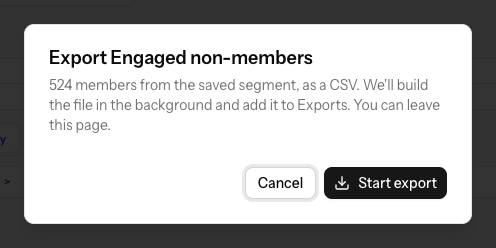
The dialog shows how many members the saved segment has. Click Start export to build the file in the background; you can leave the page. Allegro emails you a link when the file is ready, and it appears on the Exports page as Segment members: segment name.
An export always uses the segment as last saved. If you have unsaved changes, the dialog warns you that they aren't included — save first to export them. A new segment can't be exported until it has been saved.
The CSV has one row per member, with their email, sign-up date, membership and giving details, engagement totals, and first and last seen dates. See Segment member columns for the full list. Engaged time in the CSV is in seconds.
Deleting a segment
Choose Delete from a segment's row menu and confirm. Deleting is permanent.
Allegro won't delete a segment that's still in use. If any interaction (live, draft, or archived), active cohort, or meter references the segment, the dialog says This segment can't be deleted and how many of each use it. Remove the segment from them, then delete it.
Permissions
| Action | Viewer | Member | Admin |
|---|---|---|---|
| View segments, counts, and sample members | ✅ | ✅ | ✅ |
| Export a segment | ✅ | ✅ | ✅ |
| Create, edit, duplicate, and delete segments | ❌ | ✅ | ✅ |
Viewers can open any segment, but the editor is read-only for them.